Bloomerang

How Fin transformed customer support and careers at Bloomerang
Bloomerang is a fundraising and donor-management platform for nonprofits. Following multiple acquisitions, ticket volume grew at a rate faster than the team could hire for, and providing support for multiple products across different tools was negatively impacting the customer experience.
Unhappy with the service they were providing, Eric Broulette, Senior Director of Customer Support at the time, proactively went looking for a solution. He brought in Fin, an AI Customer Agent, after experiencing how well it could answer real questions by drawing on Bloomerang’s knowledge base in a sales demo.
Fast forward to today and Fin is involved in 100% of Bloomerang’s support conversations, resolving 84% of them automatically. Customers are getting fast, accurate answers and having a great experience with Fin, as evidenced by a Customer Experience Score (CX Score) of 85%.
With Fin on board, the support team at Bloomerang has completely transformed. Six team members have been promoted into new roles, and Eric himself has moved into an expanded VP role covering three additional teams.
Here’s how they made this happen.
As a company who connects nonprofits with donors, easily facilitating human connection is at the heart of what Bloomerang does. As Eric explains, “At the core, human relationships are what drives most of our customer base. When you think about how our customers choose the vendors they work with, the human connection is most important. Our support team sits at the center of that engagement, with thousands of customers every single week.”
But providing consistently excellent support was becoming increasingly challenging.
Much of Bloomerang’s product suite came together through acquisition, which resulted in Eric’s team supporting a range of different brands. “We’ve got multiple products on the go,” Eric says. “There are different customer bases, and all these different support needs, which makes things tricky.” Each brand brought its own systems with it, so support ran across three separate platforms instead of one. “The disjointed experience we were delivering, moving customers from one system to another just to speak to a human, was highly inefficient. It was starting to erode the trust that our customers had in us,” Eric reflects.
 “I needed to get out ahead of it and push AI up instead of waiting for it to be pushed down to me.”
On top of this complexity, the company was growing rapidly and the team couldn’t keep up with hiring. “Our company was growing at a remarkable rate. With that, our support volume was growing 15% to 20% year over year,” Eric recalls. “We knew we needed to get out ahead of the problem. If we were operating in the old model, things were only going to get worse, and our customer experience was going to decline pretty rapidly.”
Eric knew AI could help scale what the team could do, so without a directive from leadership, he went looking for a solution. “This was not a top-down directive,” he says. “I needed to get out ahead of it and push AI up instead of waiting for it to be pushed down to me.”
Eric evaluated several vendors before choosing Fin.
While he was impressed by the features checklist, what really sold Eric was seeing Fin in action during the sales demo. The Fin team took Bloomerang’s own public knowledge base, loaded it into Fin, and had Eric ask it real questions on the spot. “In the sales process, the Fin team was able to show us firsthand how it could help our support team,” Eric remembers. “I saw the immediate impact just in the first few conversations.”
Beyond the technology, Eric developed a strong relationship with the Fin team. “It felt like a true partnership, and I knew that the team at Fin would invest in us if we were investing in Fin as well,” he says.
The team rolled Fin out in three deliberate phases.
Phase 1: Testing with a small group of customers
First, the Bloomerang team trialed Fin with a small subset of their customer base to see what adjustments needed to be made.
They took things step by step and leant on the Fin team for guidance. Eric says, “The team at Fin was guiding us through the entire process, educating us on best practices and workflows that set us up for success in future phases.”
Phase 2: Launching to all customers
With a successful pilot under their belt, Eric’s team had the confidence to expand Fin across the rest of the customer base.
Within two months of going live, Fin was resolving close to 70% of the conversations it handled and delivering a strong CX Score, with minimal configuration.
Eric felt the impact of this most clearly during budget planning when he overlaid what Fin could realistically do onto his usual hiring forecast. “I color-code everything with conditional formatting,” he says. “I saw a lot of red turn to green. That meant our team, in its current state, was going to have additional capacity.”
Phase 3: Refining the customer experience
Fin was performing well, but there was room for improvement.
Eric had been watching Fin’s CX Score just as closely as its resolution rate, wanting to ensure the customer experience remained good as automation increased. He noticed that as the team pushed resolution rates higher, the experience started sliding in the opposite direction, and customers began abandoning the chat and turning to other channels for help. “What we were actually seeing was that customers weren’t responding when they got an incorrect answer,” Eric says. “I could see it in the numbers: our phone and email volume were both starting to climb.”
The answers Fin was getting wrong exposed gaps in Bloomerang’s documentation. To address this, the team compared how customers were phrasing questions with how their help articles were structured and rewrote accordingly. “We knew we could do more, so we created a small team focused on growing our automation rate. It’s all about small tweaks that over time lead to large outcomes,” Eric reflects.
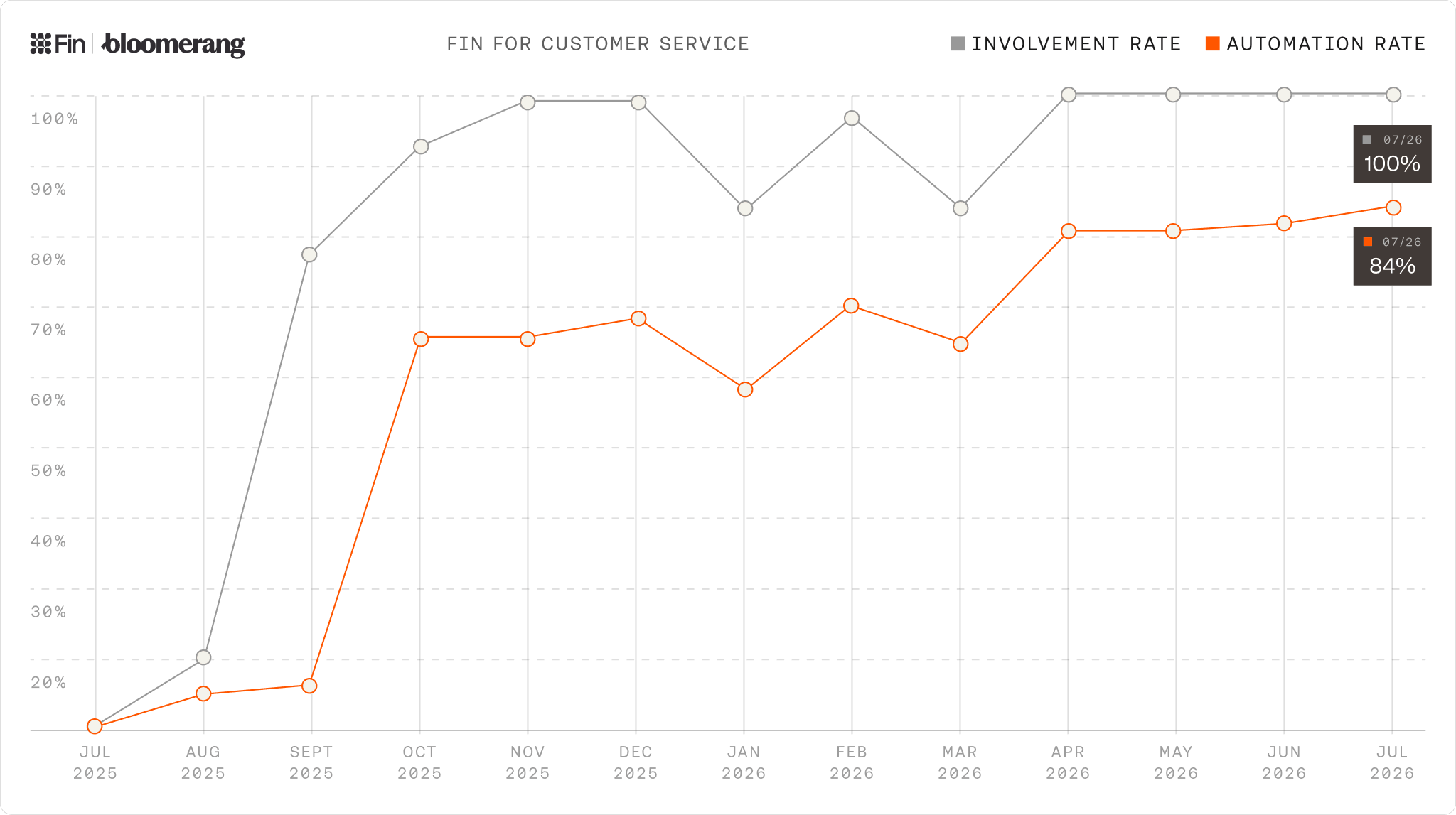
Today, Fin is involved in all of Bloomerang’s support conversations, resolving 84% of them automatically.
More importantly, Fin is helping the team protect their customer experience. Given how central human relationships are to Bloomerang’s business, that was the main concern with bringing AI on board. However, with a CX Score of 85% and customers repeatedly coming back to Fin directly (one customer spoke to it 80 times in four weeks and only needed a human rep once) it became clear that the team could trust Fin to look after customers like they would themselves.
“Our customers have reacted to Fin in a really positive way,” Eric says. “I think our automation rate being over 80% speaks to that.”
Fin has also helped transform the team’s careers at Bloomerang. More teammates were promoted into new roles in the first three months since Fin went live than in the entire year before. Reps moved into writing, onboarding, coaching, and documentation roles that didn’t exist for them before – work that only opened up because Fin had absorbed enough front-line volume to free up the capacity. “Without a tool like Fin, none of that would have been possible,” Eric says. “Our philosophy is not a cost-cutting exercise, but rather a reallocation exercise.”
Eric’s own role also changed dramatically. He picked up three new teams focused on customer education, coaching, and curriculum development, and moved into a VP position with a scope far beyond the support function he originally managed. “My role within the company has evolved,” he says. “I've had the opportunity to get in front of the company and speak more on the impact that a tool like Fin can have on our customers and our team.”
In terms of what comes next, Eric is thinking beyond just pushing Fin’s resolution rate higher. “The next phase for us is to deploy Fin across the entire customer journey, from the pre-sales motion through customer success and renewals,” he shares. “We’re not just thinking of Fin as a Support Agent, but now also as a Customer Agent that enhances our customer experience.”
Some Bloomerang customers are already behaving as if that future is here. Several use Fin as an informal onboarding tool, asking it how to use the platform rather than working through a training module or waiting on a person. This is a use case Eric didn’t fully anticipate: “It's mind-blowing how some of our customers have adopted Fin to learn how to utilize the full capabilities of our platform.”
That vision also extends to how Eric thinks the team will look like in the future. “What if your support team was actually only 10 people, and they’re just managing Agents?” he says. This possibility is what he’s started planning around.
For now, Eric’s advice to other leaders is to do what he did before ever speaking to Fin’s sales team: stop waiting for permission. “My biggest advice for any leader sitting on the fence is you just have to do it. You’ll be surprised by the amount of value it will provide for your business.”